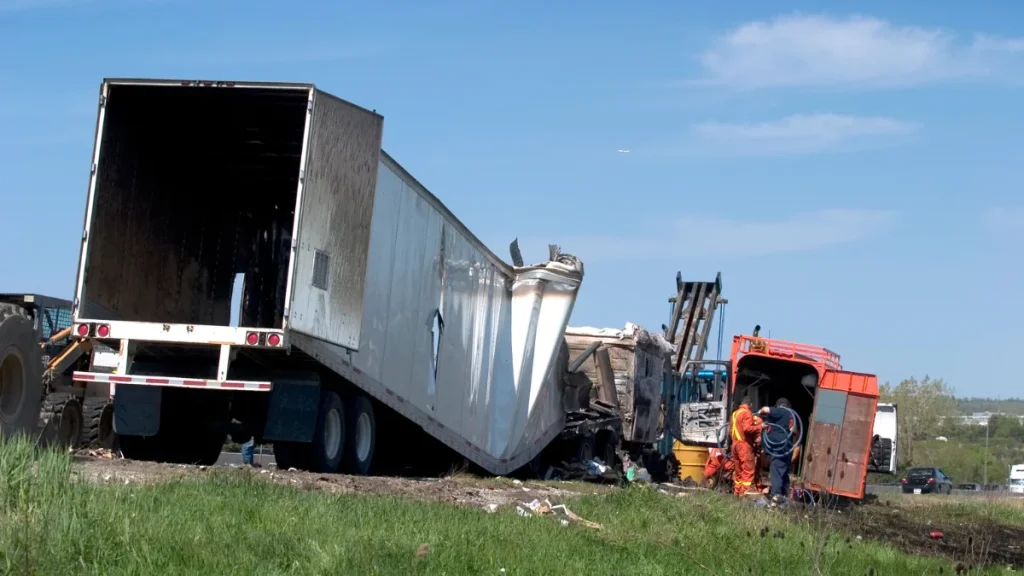
Truck jackknife accidents are among the most dangerous and destructive types of commercial vehicle crashes on Florida’s roads. When a tractor-trailer jackknifes, the trailer swings outward at an angle, often blocking multiple lanes of traffic and crushing nearby vehicles. In fast-growing areas like Wesley Chapel—where major corridors such as I-75, State Road 54, and State Road 56 experience heavy truck traffic—these accidents can cause catastrophic injuries and fatalities.
If you or a loved one was injured in a jackknife truck accident in Wesley Chapel, building a strong legal case is critical to securing the compensation you deserve. At Slater | Grant, we understand the complexity of these claims and the aggressive tactics trucking companies use to avoid responsibility. This guide explains how jackknife accidents happen, who may be liable, and how an experienced attorney can help protect your rights.
Complete the free case evaluation form or call us now at 813-995-6444 to speak directly with an attorney.
What Is a Truck Jackknife Accident?
A jackknife accident occurs when a truck’s trailer swings out of alignment with the cab, forming a sharp “V” or folding motion similar to a pocketknife. Once a truck jackknifes, the driver often loses all control of the vehicle.
Jackknife accidents commonly result in:
- Multi-vehicle pileups
- Highway shutdowns
- Severe crush injuries
- Fatal collisions
Because of the size and weight of commercial trucks, jackknife truck accidents are rarely minor.
Common Causes of Truck Jackknife Accidents in Wesley Chapel
Jackknife accidents are almost always caused by negligence. Identifying the cause is the first step in building a strong case.
1. Sudden or Improper Braking
If a truck driver brakes too hard or improperly, especially on wet or slippery roads, the trailer may swing outward.
2. Speeding
Excessive speed reduces the driver’s ability to maintain control and significantly increases stopping distance.
3. Driver Fatigue
Fatigued drivers have slower reaction times and are more likely to make braking errors.
4. Improperly Loaded Cargo
Uneven or unsecured loads can destabilize the trailer, making jackknifing more likely.
5. Mechanical Failures
Brake malfunctions, worn tires, or defective anti-lock braking systems can lead to loss of control.
6. Poor Weather Conditions
Heavy rain—common in the Wesley Chapel area—creates slick roadways that increase jackknife risk.
7. Inadequate Driver Training
Truck drivers must be trained on braking techniques, speed management, and handling adverse conditions. Inadequate training can be deadly.
Who Can Be Held Liable for a Jackknife Truck Accident?
Determining liability is one of the most important aspects of a jackknife accident claim. Several parties may be responsible, including:
1. The Truck Driver
The driver may be liable if they were:
- Speeding
- Distracted
- Fatigued
- Improperly braking
- Violating FMCSA regulations
2. The Trucking Company
Companies can be held responsible for:
- Failing to train drivers
- Encouraging unsafe driving schedules
- Neglecting maintenance
- Ignoring safety violations
- Hiring unqualified drivers
3. The Cargo Loading Company
Improperly loaded or unsecured cargo significantly increases the risk of jackknife accidents.
4. The Truck or Parts Manufacturer
Defective brakes, tires, or steering components may contribute to jackknife crashes.
5. Maintenance Providers
If routine inspections or repairs were skipped or performed improperly, maintenance companies may share liability.
Identifying all responsible parties is essential to maximizing compensation.
Key Evidence Needed to Build a Strong Jackknife Accident Case
Trucking companies act quickly after jackknife accidents to protect themselves. Preserving evidence early is critical.
At Slater | Grant, we immediately secure and analyze:
1. Black Box (Event Data Recorder) Information
This data can reveal:
- Speed before impact
- Braking behavior
- Sudden deceleration
- Steering inputs
2. Driver Logs and ELD Data
These records show whether the driver violated hours-of-service rules or falsified logs.
3. Maintenance and Inspection Records
We look for skipped inspections, worn brakes, and mechanical defects.
4. Cargo Documentation
Load weight, distribution, and securement records help determine whether improper loading caused instability.
5. Dashcam and Surveillance Footage
Video evidence often captures the moment the trailer begins to swing.
6. Accident Reconstruction Analysis
Experts analyze skid marks, vehicle damage, road conditions, and impact angles.
7. Weather and Road Condition Reports
Wet or poorly maintained roads may contribute to jackknife crashes.
Preserving this evidence quickly strengthens your case and prevents trucking companies from hiding negligence.
How FMCSA Violations Strengthen Jackknife Accident Claims
Many jackknife accidents involve violations of Federal Motor Carrier Safety Administration (FMCSA) regulations. These violations may include:
- Exceeding hours-of-service limits
- Failing to inspect brakes and tires
- Improper cargo securement
- Inadequate driver training
- Overloaded trailers
FMCSA violations can establish negligence per se, meaning the violation itself helps prove liability.
Compensation Available After a Jackknife Truck Accident
Victims of jackknife accidents often face life-altering injuries. You may be entitled to compensation for:
Economic Damages
- Emergency medical care
- Hospitalization and surgeries
- Rehabilitation and physical therapy
- Lost wages
- Loss of future earning capacity
- Ongoing medical treatment
- Property damage
Non-Economic Damages
- Pain and suffering
- Emotional distress
- Permanent disability
- Loss of enjoyment of life
- Scarring or disfigurement
Punitive Damages
In cases involving extreme negligence—such as repeated safety violations or reckless conduct—punitive damages may apply.
Why Insurance Companies Fight Jackknife Accident Claims
Because jackknife accidents often involve catastrophic injuries and multiple victims, insurance companies aggressively defend these cases. They may attempt to:
- Shift blame to weather conditions
- Blame other drivers
- Downplay FMCSA violations
- Minimize injury severity
- Pressure victims into low settlements
Without legal representation, victims are often at a disadvantage.
How Slater | Grant Builds a Powerful Jackknife Accident Case
At Slater | Grant, we use a comprehensive and aggressive strategy to protect our clients’ rights. We:
- Conduct immediate investigations
- Preserve critical evidence
- Work with trucking and safety experts
- Analyze FMCSA compliance
- Identify all liable parties
- Calculate the full value of damages
- Negotiate aggressively with insurers
- Prepare cases for trial when necessary
Our goal is to hold negligent trucking companies fully accountable.

Why Choose Slater | Grant?
Truck jackknife accidents require a law firm with the experience and resources to take on major trucking companies. At Slater | Grant, we offer:
- Extensive experience with truck accident litigation
- Deep knowledge of FMCSA regulations
- Aggressive advocacy
- Personalized client support
- No upfront fees — you pay only if we win
We fight relentlessly for justice and maximum compensation.
Take the First Step Toward Justice
If you or a loved one was injured in a truck jackknife accident in Wesley Chapel, don’t wait to protect your rights. Evidence can disappear quickly, and trucking companies begin building their defense immediately.
Start by completing the free case evaluation form or calling us now at 813-995-6444.
Slater | Grant is ready to fight for your recovery.
Sources
1. Federal Motor Carrier Safety Administration (FMCSA)
Provides federal safety regulations governing truck operations, driver training, and cargo securement.
https://www.fmcsa.dot.gov
2. National Highway Traffic Safety Administration (NHTSA)
Offers research and statistics on large truck crashes and roadway safety.
https://www.nhtsa.gov
3. Florida Highway Safety and Motor Vehicles (FLHSMV)
Provides crash reporting requirements and commercial vehicle safety information.
https://www.flhsmv.gov
4. Centers for Disease Control and Prevention – Transportation Safety
Publishes data on motor vehicle injuries and prevention strategies.
https://www.cdc.gov/transportationsafety/